What is CanFigureIt?

CanFigureIt is an online resource that is useful for both technology and mathematics learning. CanFigureIt is a geometry-based web platform that uses student-driven, problem-solving techniques to teach to students in high school. It is a free program that can be found at the following website: https://www.canfigureit.com/
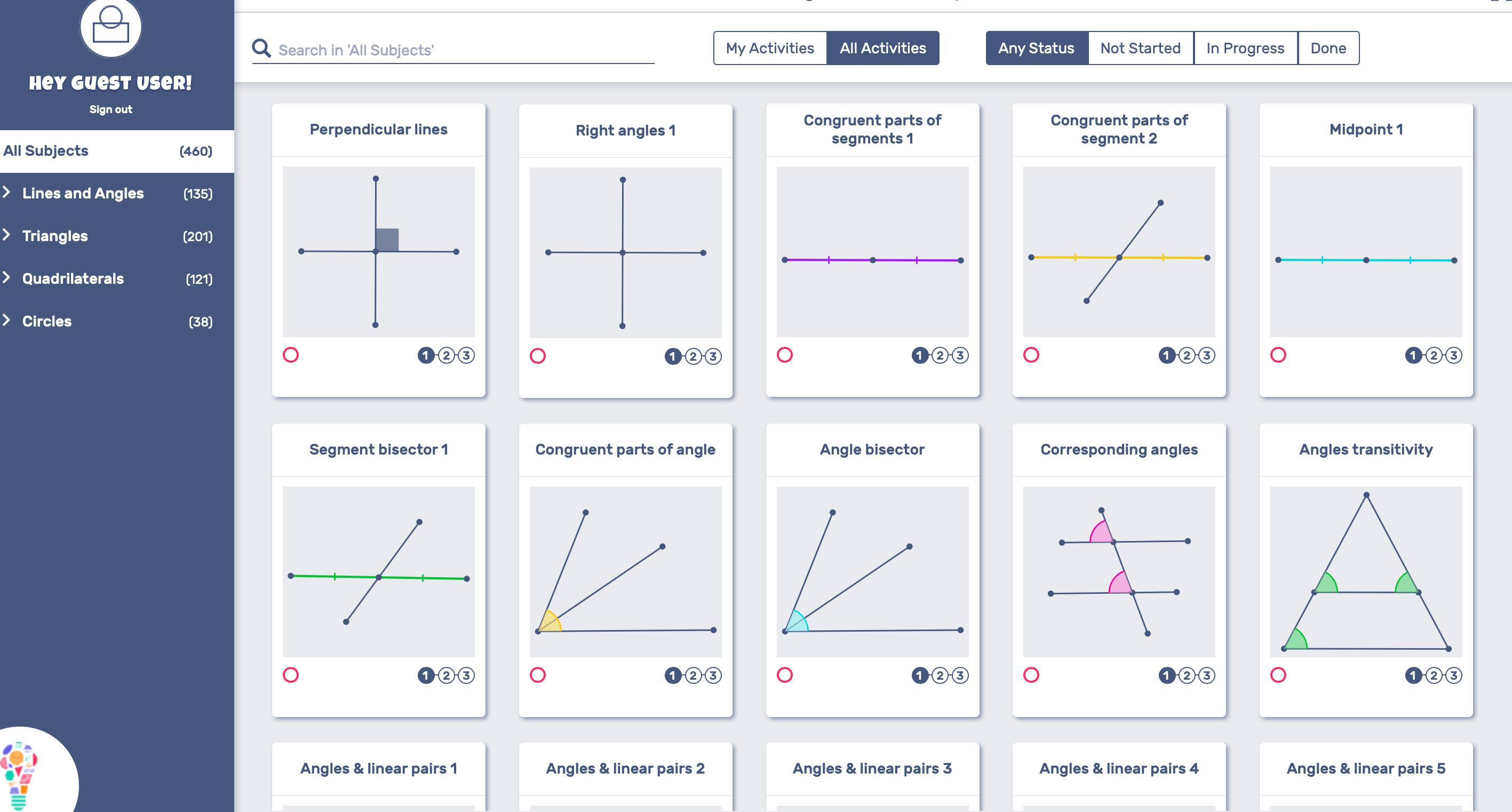
Figure 2 shows an inside-look at the platform and demonstrates a vast number of tasks regarding angles and geometric shapes. This is a view of the amount of information on this site and demonstrates its usefulness as a STEM resource.
What Year 7 & 8 VCAA outcomes does CanFigureIt support?
Identify corresponding, alternate and co-interior angles when two straight lines are crossed by a transversal (VCMMG264)
Investigate conditions for two lines to be parallel and solve simple numerical problems using reasoning (VCMMG265)
Demonstrate that the angle sum of a triangle is 180° and use this to find the angle sum of a quadrilateral (VCMMG263)
Analyse and visualise data using a range of software to create information, and use structured data to model objects or events (VCDTDI038)
Links to Academic Research & Justification:
CanFigureIt is a good STEM resources because it provides students with the ability to solve mathematical theories using proofs, which makes it perfect for a problem-based learning approach. As seen in Figure 1, the platform has close to 1,000 pre-built theories to justify, allowing for students to seek out the ones that they find most interesting, such as right-angles or parallel lines.
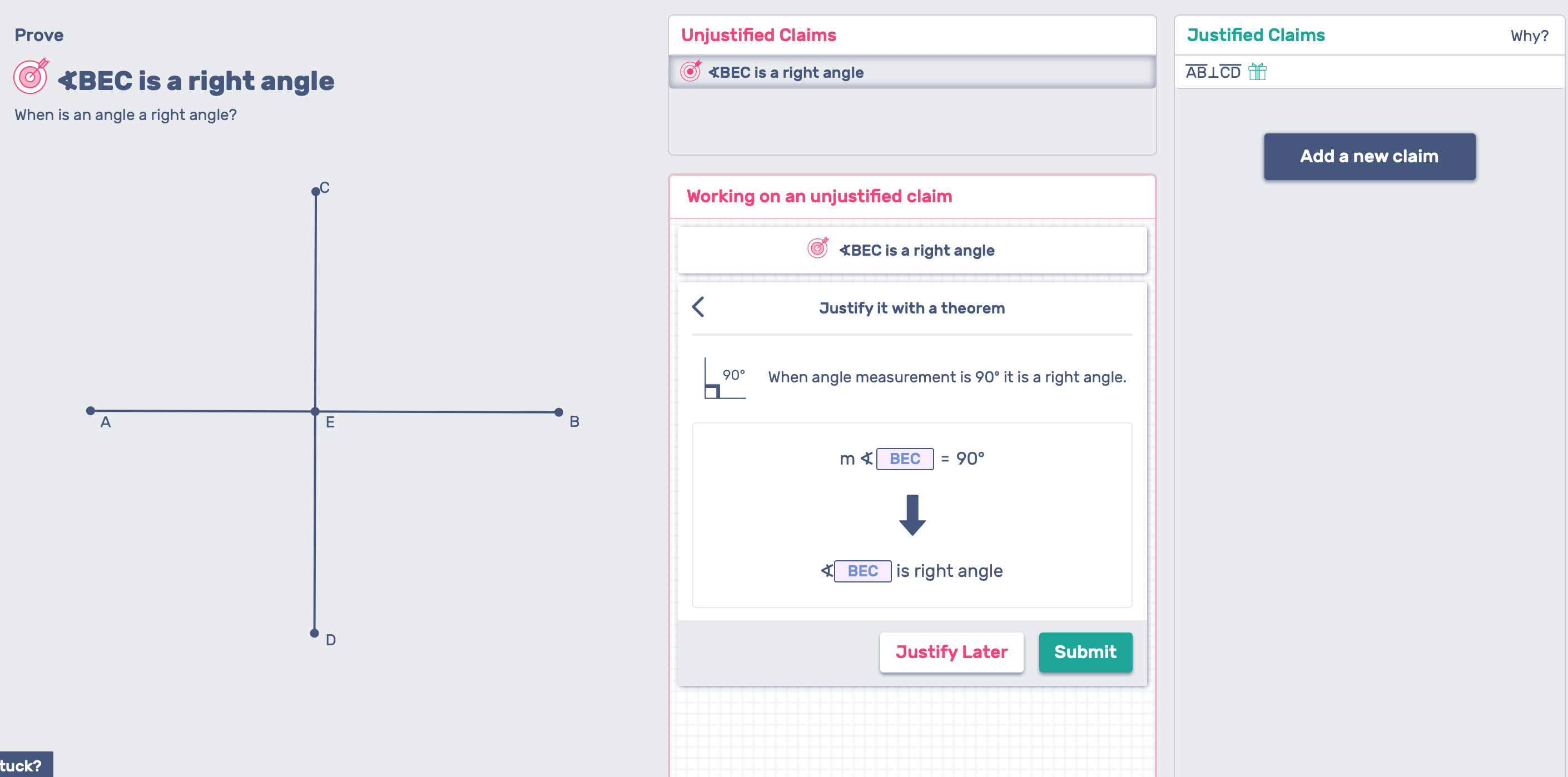
Problem-solving is an important skill in itself, and Taconis et al. note that “Problem-solving strategies play a central role in education. Many tasks performed in professional and daily life require such strategies, which we define as planned sequences of activities leading to a goal, the solution of the problem” (Taconis et al. 2000, p. 442). As seen in Figure 3, students can use this platform to virtually create and test theories, and then justify them to prove them correct.
In this manner, students can either create their own geometric shapes and angles using the resource, or solve other geometric shape and angle theories using pre-built shapes. PBL (problem-based learning) has been researched and found to be a useful teaching theory. According to Ferreira & Trudel (2012), “Researchers examining the impact of PBL on student outcomes have found that when well implemented, problem-based learning can lead to greater conceptual understanding and problem-solving skills” (p. 24).
References:
CanFigureIt ,2019, Can Figure It Geometry. [online] https://www.canfigureit.com/, retrieved 30th May 2019
Ferreira, M. M. & Trudel, A. R. 2012, ‘The Impact of Problem-Based Learning (PBL) on Student Attitudes Toward Science, Problem-Solving Skills, and Sense of Community in the Classroom’, Journal of classroom interaction, 47 (1), 23 – 30. doi: 130.194.20.173
Taconis, R., Hessler, M. & Broekkamp, H. 2000, ‘Teaching Science Problem Solving: An Overview of Experimental Work’, Journal of Research in Teaching Science, 38 (4), 442-468. retrieved from https://onlinelibrary-wiley-com.ezproxy.lib.monash.edu.au/doi/epdf/10.1002/tea.1013, retrieved 20th May 2019
Victorian curriculum and assessment authority 2017, retrieved 21st May 2019, http://victoriancurriculum.vcaa.vic.edu.au/
 STEM Resources