What is Scratch?
Scratch is a free resource aimed at ages 8 – 16, but is stated that it is designed to be used by any age group. It provides an excellent resource for technology learning, and an opportunity for users to put their maths skills to the test.

Scratch is an online resource that involves a downloadable software package, and allows users to create basic programs through a simplified method of coding.
Scratch has a large online community and allows users to share programs with each other online. The website includes step-by-step instructions to creating programs, but a third-party in-depth tutorial can be found on the following website:
https://www.youtube.com/watch?v=VIpmkeqJhmQ
What Year 7 & 8 VCAA outcomes does Scratch support?
Design the user experience of a digital system, generating, evaluating and communicating alternative designs (VCDTCD041)
Develop and modify programs with user interfaces involving branching, iteration and functions using a general-purpose programming language (VCDTCD043)
Describe translations, reflections in an axis, and rotations of multiples of 90° on the Cartesian plane using coordinates. Identify line and rotational symmetries (VCMMG261)
Link to Academic Research & Justification:
Based on Twining’s Digital Technology Impact Framework (DTIF) (Churchill et al. 2019, p. 348), Scratch can be classed as having a learning focus driven by encouraging cooperation and competition with students, with an IT skills focus. The online platform developed by Scratch allows the free sharing of programs and the ability to leave constructive criticism.
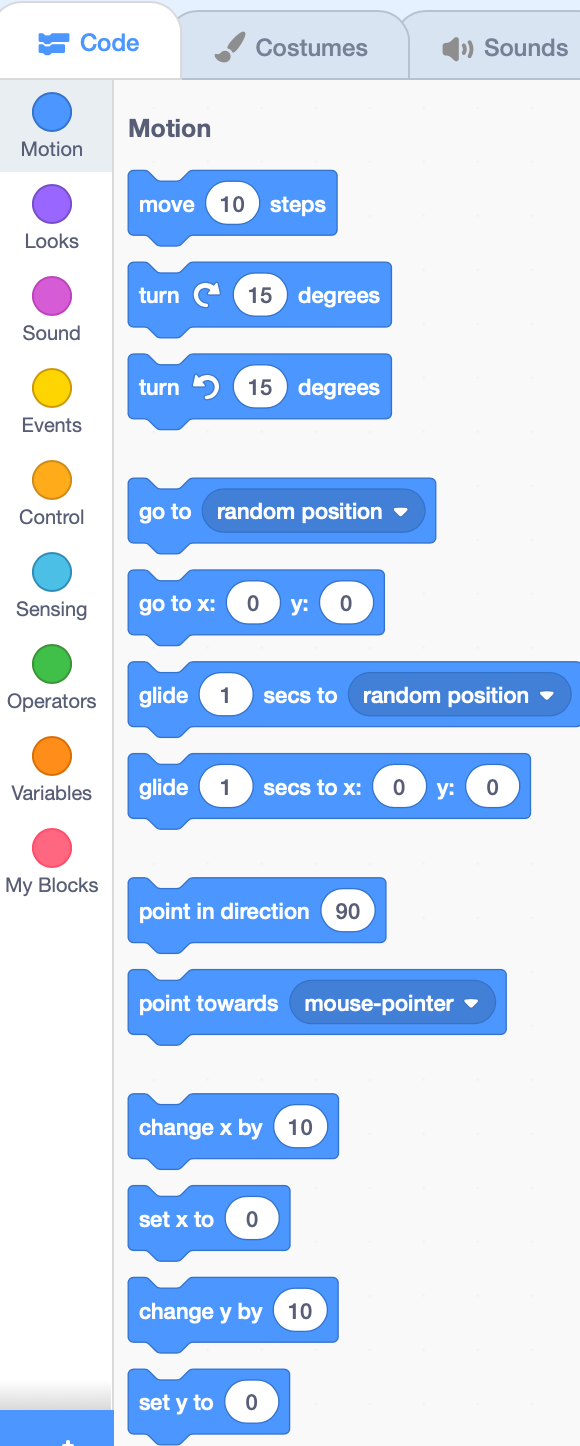
Scratch is useful for teaching mathematics as well as science: as seen in Figure 2 (right) Scratch allows students to use angles and coordinates to code. Keong, Horani & Daniel (2005) note that “ICT gives rapid and accurate feedbacks to students and this contributes towards positive motivation” and so is useful in the teaching of mathematics. They go on to say that “It also allows [students] to focus on strategies and interpretations of answers rather than spend time on tedious computational calculations” (p. 43). The ability to put mathematics skills into practice in real-life settings such as coding is a fantastic opportunity for students.
I would incorporate this with an inquiry approach to teaching, because the program allows for extensive exploration of a basic approach to computer programming (Kidman & Casinader 2017, p. 25). By being simple enough to comprehend for students, it provides a framework for students to take charge of their own learning when making their own programs.
Scratch is available from this website: https://scratch.mit.edu.
References:
Churchill, R., Godinho, S., Johnson, N., Keddie, A., Letts, W., Lowe, K., Mackay, J., McGill, M., Moss, J., Nagel, M., Shaw, K., Rogers, J., 2019, Teaching: Making A Difference, Fourth edition, Wiley & Sons Ltd Publishing.
Keong, C. C., Horani, S. & Daniel, J. 2005, A Study in the Use of ICT in Mathematics Teaching, Malaysian Online Journal of Instructional Technology (MOJIT) Vol. 2, No. 3, pp. 43-51, http://citeseerx.ist.psu.edu/viewdoc/download?doi=10.1.1.138.6507&rep=rep1&type=pdf&fbclid=IwAR3R8JBklqdnmgvmdUZu6QqEoB0owM2exnHrj1Sdk0HBdU63IcfozlT0Vlk, retrieved 25th May 2019.
Kidman, G. & Casinader, N. 2017, Inquiry-Based Teaching and Learning across Disciplines, comparative theory and practice in schools, Macmillan Publishers Ltd.
Scratcb ,2019, Scratch. [online] https://scratch.mit.edu/, retrieved 30th May 2019
Scratch Tutorial 1: Make your first program 2013, Youtube, Kevin Briggs, retrieved 20th May 2019.
Victorian curriculum and assessment authority 2017, retrieved 21st May 2019, http://victoriancurriculum.vcaa.vic.edu.au/
 STEM Resources